 New Books for Philosophy, Religion, Psychology and all other related majors!A Dialogue on Consciousness (BOOK): by Torin Alter and Robert J. Howell
 In recent years, the problem of consciousness has developed into one of the most important and hotly contested areas in the philosophy of mind. Many philosophers regard consciousness as an entirely physical phenomenon, yet it seems to elude scientific explanation. On the other hand, viewing consciousness as a nonphysical phenomenon brings up even larger issues. If consciousness is not physical, how can it be explained?
 Bible. Old Testament Proverbs X-XXXI (10-31), English. Fox. 2009: a New Translation with Introduction and Commentary (BOOK): by Michael V. Fox
As in his previous volume on the early chapters of Proverbs, the author here translates and explains in accessible language the meaning and literary qualities of the sayings and poems that comprise the final chapters. He gives special attention to comparable sayings in other wisdom books, particularly from Egypt, and makes extensive use of medieval Hebrew commentaries, which have received scant attention in previous Proverb commentaries. In separate sections set in smaller type, the author addresses technical issues of text and language for interested scholars.

Blink: the Power of Thinking Without Thinking (BOOK): by Malcolm Gladwell
Blink is about the first two seconds of looking--the decisive glance that knows in an instant. Gladwell campaigns for snap judgments and mind reading with a gift for translating research into splendid storytelling. Building his case with scenes from a marriage, heart attack triage, speed dating, choking on the golf course, selling cars, and military maneuvers, he persuades readers to think small and focus on the meaning of "thin slices" of behavior.
 Cruelty: Human Evil and the Human Brain (BOOK): by Kathleen Taylor
In Cruelty, neuroscientist Kathleen Taylor explores the factors behind violence, sexual abuse, genocide, and other atrocities. Drawing on history, politics, philosophy, psychology, and especially neuroscience, she sets cruelty in the context of human evolution and our current understanding of brain function. She begins with an example from Lithuania in World War II, in which a young man beat a group of prisoners to death, one by one, as a crowd of civilians cheered. Can the killer and his audience be described as mentally ill? Could we ever be like them? Taylor explores the beliefs, emotions, and even instincts which can lead normally decent and law-abiding people to commit shocking acts of murder.

How Do You Know?: the Economics of Ordinary Knowledge (BOOK): by Russell Hardin
How do ordinary people come to know or believe what they do? You might think I am acting irrationally--against my interest or my purpose--until you realize that what you know and what I know differ significantly. My actions, given my knowledge, might make eminently good sense. Of course, this pushes our problem back one stage to assess why someone knows or believes what they do. Russell Hardin supposes that people are not usually going to act knowingly against their interests or other purposes. To try to understand how they have come to their knowledge or beliefs is therefore to be charitable in assessing their rationality. Hardin insists on such a charitable stance in the effort to understand others and their sometimes objectively perverse actions.
Inside Jihadism: Understanding Jihadi Movements Worldwide

(BOOK): by Farhad Khosrokhavar
In studies on radical Islam that has been overwhelmed in the West by junk ideological literature and fake expertise, Farhad Khosrokhavar stands out as a true and distinguished expert with first hand and intimate knowledge. One great advantage of his approach is that it combines discourse analysis and sociology including first hand sociological research according to the best tradition of social sciences. His study of Jihadism, defined as the most radical and violent brand of Islamic fundamentalism, is a most welcome and useful addition to the serious literature on this most complex of global sociopolitical phenomena. –Gilbert Achcar, Professor at SOAS of the University of London
 Islam and the Ahmadiyya Jamaat: History, Belief, Practice (BOOK): by Simon Ross Valentine
"The Ahmadiyya Jama'at is a very personal book, written from the position of a participant observer. It is the firs
t accessible study of this Muslim community and is comprehensive in its coverage of their history, beliefs, and current existence. Simon Ross Valentine offers an inside view that will be of value to non-Muslims working with Muslims, and it is a view given with great respect." – Francis Robinson, University of London
Making Religion, Making the State: the Politics of Religion in Modern China (BOOK): edited by Yoshiko Ashiwa and David L. Wank
"This is an outstanding and much-needed contribution to the social-scientific study of religion in the modern PRC. The unifying theme is that religion occupies a certain 'space' in modern Chinese polity and society, and that that space is in constant negotiation among a multitude of actors: the central state, local state authorities, nationwide religious organizations, local religious organizations, individual religious institutions, and local society. This is an advance over previous scholarship, which tended to pit an essentialized 'religion' against an all-powerful 'state' in a two-way struggle in which the 'state' enjoyed the advantage." —Charles Jones, The Catholic University of America
On Kindness (BOOK): by Adam Phillips and Barbara Taylor
Kindness is the foundation of the world’s great religions and most-enduring philosophies. Why, then, does being kind feel so dangerous? If
we crave kindness with such intensity, why is it a pleasure we often deny ourselves? And why—despite our longing—are we often suspicious when we are on the receiving end of it?
Bursting with often shocking insight, this brief and essential book will return to its readers what Marcus Aurelius declared was mankind’s “greatest delight”: the intense satisfactions of generosity and compassion.

Perception and Cognition: Essays in the Philosophy of Psychology (BOOK): by Gary Hatfield
How do we see? This question has fascinated and perplexed philosophers and scientists for millennia. In visual perception, mind and world meet, when light reflected from objects enters the eyes and stimulates the nerves leading to activity in the brain near the back of the head. This neural activity yields conscious experiences of a world in three dimensions, clothed in colors, and immediately recognized as (say) ground, sky, grass, trees, and friends. The visual brain also produces nonconscious representations that interact with other brain systems for perception and cognition and that help to regulate our visually guided actions. But how does all of this really work? The answers concern the physiology, psychology, and philosophy of visual perception and cognition.
Psychology: Pythagoras to Present (BOOK): by John C. Malone
Certain ideas have preoccupied thinkers since ancient times: the nature of mind, the sources of knowledge and belief, the nature of the self, ethics and the best way to lead our lives, the question of free will. In this book, John Malone examines these ideas in the writings of thinkers from antiquity to the present day and argues for their importance not just as precursors of modern views but as ideas that are frequently better than current ones.
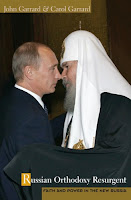
Russian Orthodoxy Resurgent: Faith and Power in the New Russia (BOOK): by John Garrard and Carol Garrard
Savagely persecuted, the Russian Orthodox Church has experienced a remarkable revival in the past two decades. Led by its patriarch, Aleksy II, the renaissance has not been as simple as picking up where 1917 left off. The historical Church was too intimately connected with czarist autocracy for that. Examining the restoration process, the Garrards touch on certain reconnections with the pre-revolutionary Church in consecrations conducted in the beautiful Orthodox liturgy of church buildings and monasteries returned to it by post-Communist Russian governments. But they also focus on Aleksy II’s agenda both to reroute Russian Orthodoxy to its claim as the true apostolic succession in Christendom (a challenge to Roman Catholicism’s rival claim) and to re-identify it with Russian nationalism. An important work for students of contemporary Russia. – Gilbert Taylor
 The Great Divorce: a Dream (BOOK): by C.S. Lewis
'Mr. Lewis rouses curiosity about life after death only to sharpen awareness of this world.' Guardian "Lewis, perhaps more than any other twentieth century writer, forced those who listened to him and read his works to come to terms with their own philosophical presuppositions." –Los Angeles Times
The Narcissism Epidemic: Living in the Age of Entitlement (BOOK): by Jean M. Twenge and W. Keith Campbell
Twenge and Campbell, psychologists and authors of previous books on self-admiration, team up for a thorough look at a troubling trend that has broad cultural implications. They begin by chronicling changes in American culture that have brought us Botox, fake paparazzi, and MySpace. The authors distinguish between self-esteem and narcissism, drawing on scientific research, but focus on narcissistic personality traits “among the normal population” and cultural narcissism that goes deep into social values. The authors debunk myths about narcissism—that it is necessary in order to be competitive and that narcissists are actually overcompensating for low self-esteem. Although young girls have been hit hardest by the narcissism epidemic, with unrealistic notions of physical beauty, the scourge has affected us all—witness Wall Street greed and the mortgage crisis with its overblown sense of materialism and entitlement. The authors argue that the nation needs to recognize the epidemic and its negative consequences, and take corrective action. — Vanessa Bush
The Social Neuroscience of Empathy (BOOK): edited by Jean Decety and William Ickes
"Social neuroscience is providing compelling, novel insights into fundamental human capacities, such as the ability to understand the minds of others to empathize with them. This volume provides readable, up-to-date reviews of theories and research that cross levels of analysis from groups to neurons, with applications ranging from education to psychotherapy. Experts and students alike will benefit from this timely review. A superb read for all those interested in the social brain."
—Todd F. Heatherton

 After the Prophet: The Epic Story of the Shia-Sunni Split in Islam (BOOK): by Lesley Hazleton
 Beauvoir and Sartre: The Riddle of Influence (BOOK): edited by Christine Daigle and Jacob Golomb
 Bettelheim: Living and Dying (BOOK): by David James Fisher
 Conflict and Creativity at Work: Human Roots of Corporate Life (BOOK): by Albert Low
 Ecotherapy: Healing with Nature in Mind (BOOK): edited by Linda Buzzell and Craig Chalquist foreword by David W. Orr
 Essentials of Myers-Briggs Type Indicator Assessment (BOOK): by Naomi L. Quenk


